

Pinterest has become an important platform for businesses, bloggers, affiliate marketers, online stores, and content creators who want to attract consistent traffic. However, managing a Pinterest account manually can become time-consuming when you need to create, organize, schedule, and publish a large number of pins. This is where a Pinterest Automation Tool can make a major difference.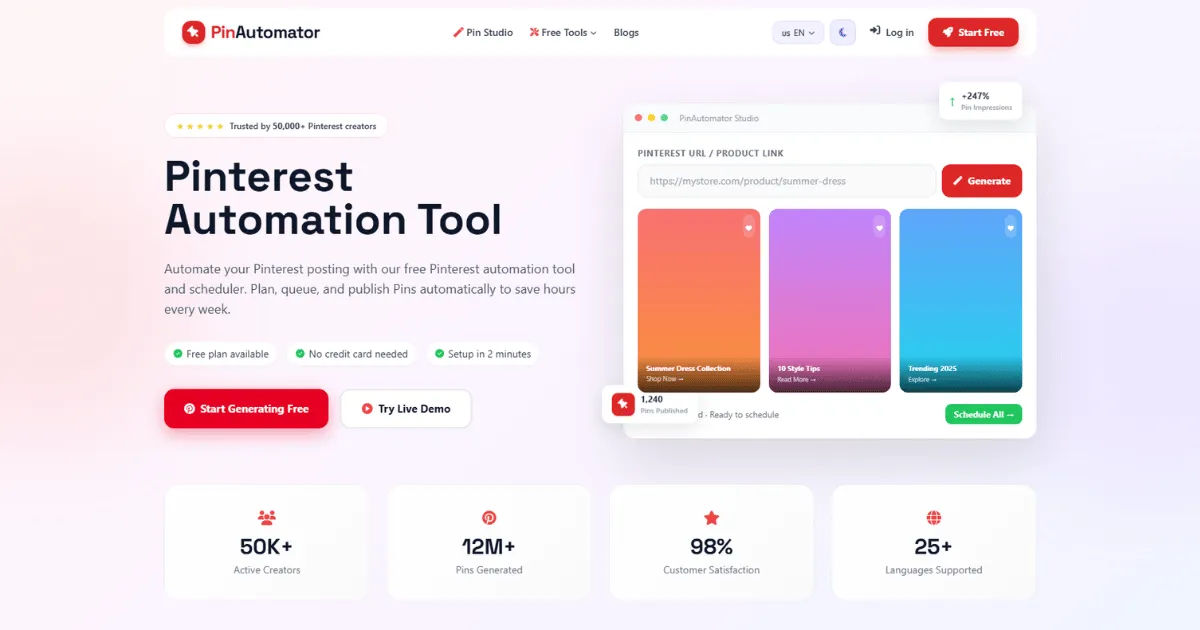
A Pinterest Automation Tool is designed to simplify repetitive Pinterest marketing tasks and help users manage content at scale. Instead of manually publishing every pin one by one, marketers can prepare multiple pieces of content and schedule them for publication over time. This process, commonly known as bulk pinning, can make Pinterest marketing more organized and efficient.
Bulk pinning is not simply about uploading hundreds of pins at once. Effective bulk publishing requires planning, scheduling, content organization, image optimization, descriptions, links, and appropriate publishing intervals. A good automation system helps coordinate these activities so that a Pinterest account can remain active without requiring constant manual attention.
Understanding how bulk pinning works is important for anyone considering automation. It can help businesses save time, maintain a consistent publishing schedule, and distribute content more efficiently. At the same time, automation should be used carefully. Excessive or repetitive activity can reduce content quality and may create an unnatural experience for users.
This comprehensive guide explains how bulk pinning works, how automation tools manage large content libraries, what features are commonly available, and how to use automation responsibly for long-term Pinterest growth.
What Is Bulk Pinning on Pinterest?
Bulk pinning refers to the process of preparing and publishing multiple pins through a structured workflow rather than creating and publishing each pin individually.
For example, imagine a website that publishes 20 blog posts every month. Each blog post may have several Pinterest graphics designed to promote it. If the marketer manually creates and publishes every pin, the process can require many hours.
With a bulk-publishing workflow, the marketer can prepare a collection of pins in advance. The images, titles, descriptions, destination links, and publishing dates can then be organized into a queue.
The system processes this queue according to the selected schedule.
This does not necessarily mean that every pin is published simultaneously. In fact, responsible bulk pinning usually works by distributing content across a defined period. The purpose is to reduce manual work while maintaining a steady publishing rhythm.
Bulk pinning can be useful for several types of Pinterest users. Bloggers can promote their articles, ecommerce stores can showcase products, affiliate marketers can distribute content, and agencies can manage multiple client accounts.
The key advantage is organization. Instead of repeatedly returning to Pinterest to publish individual pieces of content, marketers can prepare content in batches and manage the publishing process from a central workflow.
How Does a Pinterest Automation Tool Manage Bulk Pinning?
A Pinterest Automation Tool generally handles bulk pinning through a combination of content importing, scheduling, queue management, and automated publishing.
The exact process depends on the software, but most systems follow a similar general workflow.
First, the user prepares the content. This may include pin images, titles, descriptions, links, and board selections.
Next, the content is imported into the automation system. Some tools may allow users to upload spreadsheets, connect content feeds, import information from a website, or add pins individually.
After the content is imported, the user can organize it into a publishing queue.
The queue determines when individual pins are expected to be published. Instead of publishing everything at once, the tool distributes the content according to the selected schedule.
The automation system then manages the publishing workflow. Depending on the platform's available features and policies, the tool may publish or schedule content through approved integrations or provide scheduling functionality.
This process reduces repetitive manual tasks. The marketer still creates and approves the content, but the software handles much of the organizational work.
A well-designed automation workflow therefore focuses on efficiency rather than uncontrolled volume.
The First Step: Preparing Pins in Bulk
Before bulk pinning can begin, the content must be prepared.
This usually starts with creating a collection of Pinterest-ready images. Since Pinterest is a highly visual platform, the quality and relevance of the images are extremely important.
A business may create several graphics for one article. Each image can use a different headline, design, or visual concept while linking to the same destination page.
Once the images are prepared, the marketer can organize them into folders or categories.
For example, a food blog might separate pins into categories such as breakfast recipes, dinner recipes, desserts, and healthy meals.
A digital marketing agency might organize client content by brand, campaign, or website.
This organization becomes especially important when hundreds or thousands of pins are involved.
A Pinterest Automation Tool can help manage these large content collections by keeping important information together. Depending on the software, users may be able to store images, descriptions, links, and publishing information in a structured system.
Good preparation makes automation much easier.
Importing Multiple Pins
One of the most important features in bulk pinning is the ability to import multiple pins efficiently.
Manually entering information for hundreds of pins can defeat the purpose of automation. Therefore, many automation platforms offer bulk-import features.
A common method is spreadsheet-based importing.
The marketer may prepare a spreadsheet containing information such as the image location, pin title, description, destination URL, board, and scheduled date.
The data can then be uploaded into the automation platform.
The tool reads the information and converts each row into an individual publishing task.
This approach is particularly useful for large campaigns because spreadsheets are easy to organize and review before uploading.
Another approach is content feed integration.
Some systems can connect to a website's RSS feed or another content source. When new content becomes available, the automation workflow may help prepare it for Pinterest distribution.
This can be useful for publishers that regularly produce new articles.
However, automated importing should not replace human quality control. Every imported item should be reviewed to ensure that the image, description, link, and board selection are appropriate.
Creating a Publishing Queue
After pins are imported, they are usually placed into a queue.
The queue is essentially a list of content waiting to be published or scheduled.
For example, a marketer might have 500 prepared pins. Instead of publishing them all immediately, the automation system can organize them according to a publishing calendar.
The queue may contain pins scheduled for different days and times.
This creates a more manageable workflow.
A queue also makes it easier to maintain consistency. If a marketer knows that several pins need to be published each week, the automation system can help distribute those posts according to the selected schedule.
The queue can also reduce the need for daily manual publishing.
Rather than opening Pinterest every morning to publish content, the marketer can prepare the content in advance and allow the scheduled workflow to handle the routine tasks.
The user can still monitor the account and make adjustments when necessary.
Scheduling Pins Across Different Times
Scheduling is one of the main reasons businesses use automation.
Bulk pinning becomes much more effective when content is distributed over time.
For example, a website may have 100 pins ready for promotion. Publishing all 100 at once would not create a sustainable long-term content strategy.
Instead, the pins can be spread across multiple days or weeks.
A scheduling system allows marketers to create a publishing calendar.
The user can select preferred publishing times and determine how frequently new content should enter the queue.
Some tools may offer recurring schedules. Others may allow specific dates and times.
The most appropriate schedule depends on the account, audience, content type, and marketing goals.
The important principle is consistency.
A Pinterest Automation Tool should support a planned publishing strategy rather than encourage excessive activity.
Managing Multiple Boards
Pinterest accounts often contain multiple boards, each focused on a specific subject.
Bulk pinning becomes more complicated when content needs to be distributed across different boards.
For example, a home decor website might have separate boards for bedrooms, kitchens, living rooms, bathrooms, and outdoor spaces.
A bulk automation system can help organize pins according to their intended boards.
During the preparation process, the marketer can assign each pin to an appropriate category or board.
The automation workflow then uses that information when scheduling the content.
This can save significant time.
However, board selection should always be relevant.
A pin about kitchen design should not be placed on a board dedicated to unrelated topics simply because the board has a large audience.
Relevance helps maintain a logical account structure and improves the overall user experience.
How Automation Handles Pin Descriptions
Images may attract attention, but descriptions provide additional context.
A good description explains what the pin is about and helps users understand why they should click.
When handling bulk pinning, automation tools may allow descriptions to be imported alongside images.
For example, a spreadsheet might contain a unique description for every pin.
This approach is generally better than using the same description repeatedly.
Different pins can promote the same article while using different wording. This allows the marketer to highlight different aspects of the content.
For example, one pin might focus on a beginner-friendly guide, while another highlights a specific tip from the same article.
Automation makes it easier to manage these variations at scale.
However, descriptions should still be written for real users. Automation should not result in meaningless keyword stuffing or repetitive text.
Managing Destination Links
Every promotional pin usually needs a destination.
This could be a blog post, product page, landing page, category page, or another relevant resource.
Bulk-publishing workflows often store destination URLs with the corresponding pin information.
This makes it possible to connect each image with the correct page.
Link management is especially important when handling hundreds of pins.
A single incorrect URL can send visitors to the wrong page or create a poor user experience.
Therefore, marketers should review links before launching a bulk campaign.
It is also useful to check whether destination pages are working correctly.
A Pinterest Automation Tool can reduce the manual work associated with publishing links, but it cannot replace the need for accurate content management.
Using Spreadsheets for Large-Scale Pinning
Spreadsheets are one of the most practical tools for managing large pin campaigns.
A spreadsheet can act as a central content database.
Columns may include the following information:
-
Pin title
-
Pin description
-
Image file
-
Destination URL
-
Board
-
Publishing date
-
Publishing time
-
Campaign name
-
Content category
Once this information is organized, it can be imported into an automation platform if the software supports bulk uploads.
This workflow is particularly helpful for agencies and businesses that manage large content libraries.
It also creates a record of the campaign.
If a problem occurs, the marketer can return to the spreadsheet and identify the affected pins.
The main advantage is structure.
Without organization, bulk pinning can quickly become confusing.
How Automation Helps Avoid Repetitive Manual Work
Publishing a single pin manually is relatively simple.
Publishing hundreds of pins manually is a different matter.
The repetitive nature of the process can consume valuable time.
A Pinterest Automation Tool reduces this burden by handling routine activities within the available scheduling and publishing workflow.
Instead of repeatedly entering the same types of information, the marketer can prepare content in batches.
This allows more time to focus on strategy.
For example, a business owner can spend less time managing individual publishing tasks and more time creating better content, improving website pages, researching audiences, or analyzing performance.
Automation is therefore most valuable when it removes repetitive administrative work.
It should not eliminate strategic decision-making.
Bulk Pinning and Content Recycling
One of the more advanced uses of automation is content recycling.
Many websites have valuable older content that remains relevant.
For example, an article about beginner gardening may continue to attract readers for several years.
A marketer can create multiple Pinterest graphics for that article and distribute them over time.
Content recycling can help extend the useful life of existing content.
However, recycling should be handled carefully.
The same exact pin should not necessarily be repeated endlessly.
Instead, marketers can create fresh visual designs, update descriptions, or highlight different aspects of the original content.
This makes the content more useful and reduces unnecessary repetition.
Automation can help manage these variations by keeping them organized within a content queue.
How Bulk Pinning Supports Content Marketing
Pinterest often works best when it is connected to a broader content marketing strategy.
For example, a company may publish a blog article and then create multiple Pinterest graphics to promote it.
The Pinterest content can become another distribution channel for the article.
Bulk pinning makes this strategy easier to manage.
Instead of treating every pin as an isolated task, marketers can build a content distribution system.
One article may generate several visual assets.
Those assets can then be scheduled across an extended period.
This approach can help businesses make better use of the content they have already invested in creating.
The goal is not simply to publish more pins.
The goal is to distribute valuable content to the right audience consistently.
Managing Large Pin Libraries
As Pinterest accounts grow, their content libraries can become extremely large.
A marketer may eventually have hundreds or thousands of images.
Without proper organization, finding specific pins can become difficult.
Automation platforms may provide organizational features such as folders, tags, categories, or campaign labels.
For example, pins could be grouped by:
-
Content topic
-
Website category
-
Marketing campaign
-
Season
-
Product
-
Target audience
This structure makes bulk pinning easier to manage.
It also helps marketers identify which content has already been used.
A well-organized content library reduces duplication and makes future campaigns faster to prepare.
Bulk Pinning for Ecommerce Businesses
Ecommerce businesses can benefit significantly from structured bulk pinning.
An online store may have hundreds of products.
Creating promotional pins for every product manually can require substantial time.
Bulk workflows can help organize product images and associated destination pages.
For example, a fashion store might create separate pin groups for dresses, shoes, accessories, and seasonal collections.
Each pin can connect to the relevant product or category page.
This creates a scalable content distribution process.
However, product information must remain accurate.
If a product is discontinued, sold out, or significantly changed, the associated pin should be reviewed.
Automation does not remove the need for ongoing content maintenance.
Bulk Pinning for Bloggers
Bloggers are another major group that can benefit from automation.
A blogger may have hundreds of articles published over several years.
Many of those articles may still be useful to readers.
A bulk-pinning strategy can help promote both new and evergreen content.
For example, a travel blogger might have articles about destinations, packing tips, travel planning, and budget advice.
Each article can have several Pinterest graphics.
A Pinterest Automation Tool can help schedule these graphics according to a long-term content calendar.
This approach allows the blogger to continue promoting older content while publishing new material.
The result is a more balanced content strategy.
Bulk Pinning for Marketing Agencies
Agencies often manage Pinterest accounts for multiple clients.
This creates additional challenges because each client may have different branding, audiences, boards, and content strategies.
Automation can help agencies organize campaigns separately.
Each client can have its own content library and publishing schedule.
This makes it easier for team members to coordinate work.
It can also reduce the amount of time spent performing repetitive publishing tasks.
However, agencies should maintain strict quality control.
Every client's content should be reviewed individually.
Automation should support customization rather than turn every client account into an identical publishing system.
How Automation Can Improve Consistency
Consistency is one of the biggest benefits of scheduled bulk pinning.
A marketer may be highly active one week and extremely busy the next.
Without a scheduling system, Pinterest activity can become irregular.
Automation helps maintain a planned publishing rhythm.
Content can be prepared when the marketer has time and scheduled for later.
This separates content creation from content publication.
That separation can make marketing workflows more efficient.
It also reduces the pressure of having to create and publish content every single day.
Avoiding Over-Automation
Automation is useful, but too much automation can create problems.
The biggest mistake is assuming that more automation always produces better results.
Pinterest marketing still requires human judgment.
Marketers need to understand their audience, create useful content, design attractive graphics, and monitor performance.
Automation should handle repetitive tasks while humans remain responsible for strategy.
Over-automation can also lead to repetitive content.
If every pin uses identical descriptions, images, and messaging, the account may appear low quality.
A strong strategy combines automation with creativity.
Why Quality Matters in Bulk Pinning
Bulk pinning should never become an excuse for producing low-quality content.
Pinterest users are exposed to a large amount of visual content.
A pin needs to be useful, relevant, and visually appealing to stand out.
Quality includes several elements.
The image should be clear and professionally designed.
The title should accurately describe the content.
The description should provide meaningful context.
The destination link should lead to a relevant page.
The overall message should match what the user expects after clicking.
Automation can help publish these elements efficiently, but it cannot make poor content valuable.
The quality of the original material remains the foundation of the campaign.
Monitoring Automated Pinning
Even when a campaign is automated, it should still be monitored.
Marketers should regularly review scheduled content.
This can help identify broken links, outdated information, incorrect boards, or inappropriate publishing patterns.
Monitoring also provides an opportunity to evaluate performance.
If certain content consistently performs well, marketers can study what makes it successful.
If another category performs poorly, the strategy can be adjusted.
Automation should therefore be viewed as an ongoing process rather than a set-it-and-forget-it solution.
Tracking Pinterest Performance
Bulk pinning becomes more valuable when marketers measure results.
Useful performance indicators may include impressions, saves, outbound clicks, and engagement.
Website analytics can also help identify how much traffic Pinterest sends to a website.
For ecommerce businesses, the ultimate goal may be sales or conversions.
For bloggers, the goal may be page views, email sign-ups, or advertising revenue.
Different businesses will measure success differently.
The important point is that publishing volume should not be the only measurement.
A campaign with fewer high-quality pins may outperform a campaign with a much larger number of low-quality posts.
Automation should support meaningful outcomes.
Understanding the Difference Between Scheduling and Automation
The terms scheduling and automation are sometimes used interchangeably, but they are not always identical.
Scheduling generally means preparing content in advance and assigning future publishing times.
Automation can refer to a broader range of processes, including content importing, queue management, recurring scheduling, and other repetitive workflows.
A scheduling system may simply publish content at selected times.
A more advanced automation platform may manage several stages of the workflow.
Understanding this difference helps marketers choose the right solution.
Someone who only needs to schedule a few pins per week may not need an extensive automation system.
A large agency managing thousands of pieces of content may require more advanced capabilities.
Security and Account Safety
Account security should always be considered when using third-party tools.
Users should carefully evaluate how a tool connects to Pinterest and what permissions it requires.
Whenever possible, marketers should use legitimate integrations and established platforms.
They should also avoid services that promise unrealistic results through aggressive or suspicious automation.
Account credentials should be protected.
Businesses should also ensure that team members have appropriate access levels.
Security is especially important for agencies managing multiple client accounts.
A reliable workflow should prioritize both efficiency and account protection.
Following Pinterest's Rules
Automation should always be used responsibly.
Pinterest has rules and policies that govern acceptable platform activity.
Users should review current platform guidelines before implementing an automated publishing strategy.
The exact rules and available features may change over time.
Therefore, marketers should not assume that a technique that worked previously is always appropriate.
The safest approach is to use automation for legitimate content management rather than attempting to manipulate platform activity.
The goal should be to share useful content with relevant audiences.
A sustainable strategy focuses on quality, relevance, and consistency.
Common Mistakes in Bulk Pinning
One common mistake is uploading too much content without reviewing it.
Another is using identical descriptions for every pin.
Some marketers also make the mistake of assigning pins to irrelevant boards.
Broken links are another frequent problem.
Publishing outdated information can also reduce content quality.
A lack of performance monitoring is another issue.
These mistakes demonstrate why automation should not be completely unsupervised.
The best results usually come from combining efficient technology with human oversight.
How to Build an Effective Bulk Pinning Workflow
A successful workflow begins with content planning.
First, identify the content that deserves promotion.
Next, create multiple high-quality pin designs where appropriate.
Prepare unique titles and descriptions that accurately represent each piece of content.
Organize the material into categories.
Check destination links.
Assign suitable boards.
Import the content into the scheduling system.
Create a realistic publishing calendar.
Review the queue before publication.
After the content is published, monitor performance and make adjustments.
This process creates a repeatable system that can scale as the business grows.
The Role of Human Creativity in Automated Pinterest Marketing
Automation cannot replace creativity.
Pinterest is fundamentally a visual discovery platform, so creative thinking remains essential.
Marketers need to understand what catches attention.
They need to experiment with layouts, headlines, images, and topics.
Automation simply helps distribute those creative assets efficiently.
For example, a designer may create five different versions of a pin promoting the same article.
The automation system can then help organize and schedule those versions.
The human creates the strategy.
The technology supports execution.
This combination is often more effective than relying entirely on either manual work or automation.
Benefits of Using a Pinterest Automation Tool for Bulk Pinning
The biggest benefit is time savings.
Instead of repeatedly performing individual publishing tasks, marketers can prepare content in batches.
Another advantage is consistency.
A scheduled workflow makes it easier to maintain regular activity.
Organization is another major benefit.
Large collections of pins can be categorized and managed more efficiently.
Automation can also support scalability.
A small blogger and a large agency may both use the same basic principles, although their workflows will differ in size and complexity.
Finally, automation allows marketers to focus more attention on strategy, content creation, and performance analysis.
Potential Limitations of Automation
Automation is not perfect.
Some tools may have limitations on the number of pins that can be scheduled.
Others may not support every type of content or workflow.
Importing data can also create errors if spreadsheets are incorrectly formatted.
There may also be a learning curve when setting up a large campaign.
Most importantly, automation does not guarantee success.
A poorly designed marketing strategy will not become successful simply because it is automated.
The tool is only as effective as the content and strategy behind it.
Is Bulk Pinning Suitable for Everyone?
Bulk pinning can be useful for many Pinterest users, but the ideal approach depends on the size and goals of the account.
A small creator who publishes only occasionally may prefer manual scheduling.
A large ecommerce business may benefit from a more structured bulk workflow.
Agencies managing multiple accounts may require advanced organizational features.
The important question is not whether automation is popular.
The question is whether it solves a real workflow problem.
If manual publishing is consuming too much time, automation may be worth considering.
If the account only needs a few posts each month, a complex system may be unnecessary.
Best Practices for Using Automation Responsibly
The first best practice is to prioritize quality.
Every pin should have a clear purpose.
The second is to maintain variety.
Use different visual designs and messaging when appropriate.
The third is to review scheduled content regularly.
The fourth is to monitor performance and adjust the strategy.
The fifth is to keep links and information updated.
Finally, stay aware of Pinterest's current policies and available publishing methods.
Responsible automation is about efficiency without sacrificing authenticity.
The Future of Bulk Pinning
As digital marketing becomes more competitive, content management systems are likely to become increasingly sophisticated.
Automation tools may continue to improve their scheduling, analytics, content organization, and workflow capabilities.
Artificial intelligence may also play a larger role in helping marketers generate content ideas, organize campaigns, and identify patterns in performance.
However, human oversight will remain important.
Technology can help manage information at scale, but successful marketing still depends on understanding people.
The most effective future workflows will likely combine automation with creativity, strategic planning, and careful analysis.
Conclusion
Bulk pinning can transform Pinterest marketing from a repetitive daily task into a more organized and scalable content distribution process. By allowing marketers to prepare content in batches, organize large pin libraries, schedule publications, and manage multiple campaigns, a Pinterest Automation Tool can significantly reduce the amount of manual work involved in maintaining an active Pinterest presence.
However, effective bulk pinning is about much more than publishing a large number of pins. The real value comes from creating a structured system that connects high-quality content with an appropriate publishing strategy. Images need to be visually appealing, descriptions should be useful, links must be accurate, and boards should be relevant.
A Pinterest Automation Tool works best when it supports these goals rather than replacing them. Automation can handle repetitive activities, but marketers still need to make important decisions about content quality, audience needs, branding, and campaign strategy.
The most successful approach is usually a balanced one. Marketers can create content manually, prepare it in batches, organize it systematically, and then use automation to manage the publishing schedule. This approach saves time while preserving human creativity and control.
Bulk pinning can also make long-term content promotion easier. Evergreen blog posts, product pages, tutorials, and other valuable resources can continue to be distributed over time instead of being promoted only once. With proper planning, businesses can build a sustainable content library that supports ongoing traffic generation.
At the same time, marketers should avoid the temptation to automate everything. Excessive repetition, poor-quality content, irrelevant boards, broken links, and careless publishing can weaken a Pinterest strategy. Automation should always be combined with regular monitoring and human review.
Ultimately, the purpose of a Pinterest Automation Tool is not simply to increase the number of pins published. Its real purpose is to make content management more efficient so marketers can spend more time on the activities that require human creativity and strategic thinking.
When used responsibly, bulk pinning can help bloggers, ecommerce businesses, publishers, affiliate marketers, and agencies create a more consistent Pinterest workflow. The strongest results come from combining thoughtful content creation, organized planning, realistic scheduling, performance tracking, and responsible automation.
In other words, automation should be viewed as a support system rather than a shortcut to success. A well-planned strategy supported by the right technology can make Pinterest marketing easier to manage, more scalable, and more sustainable over the long term.

Leave a Reply