

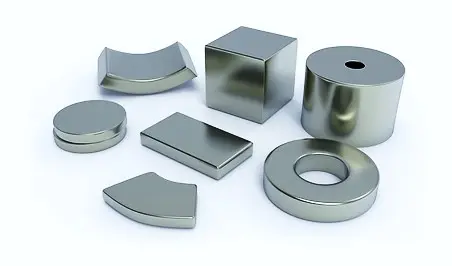
Magnetic materials are an essential part of modern technology, from everyday consumer electronics to specialized industrial applications. These materials are capable of producing magnetic fields or responding to external magnetic fields. They play a crucial role in electrical devices, electric motors, transformers, sensors, data storage systems, and much more. The integration of these magnetic materials into assemblies enhances their functionality, enabling a range of complex applications that power our technological infrastructure.
1. What are Magnetic Materials?
Magnetic materials are substances that have the ability to attract or repel other materials due to their intrinsic magnetic properties. These materials can be broadly categorized based on their response to external magnetic fields. The key classifications of magnetic materials are:
-
Ferromagnetic Materials: These materials are strongly attracted to magnetic fields and can retain magnetization even after the external magnetic field is removed. Examples include iron, cobalt, and nickel. Ferromagnetic materials have a high magnetic permeability, which means they can conduct magnetic fields efficiently.
-
Paramagnetic Materials: These materials are weakly attracted to magnetic fields and do not retain magnetization once the external field is removed. Aluminum and platinum are examples of paramagnetic materials.
-
Diamagnetic Materials: These materials create an induced magnetic field in the opposite direction to the applied magnetic field, causing them to be weakly repelled. Examples include copper, graphite, and water.
-
Antiferromagnetic Materials: In these materials, the magnetic moments of adjacent atoms or ions align in opposite directions, resulting in a net magnetic moment of zero. Manganese oxide and iron oxide are typical antiferromagnetic materials.
-
Ferrimagnetic Materials: Similar to antiferromagnetic materials, ferrimagnetic materials have magnetic moments that oppose each other but not to the same extent, leading to a net magnetic moment. Ferrites (ceramic compounds of iron oxide) are common examples.
2. Properties of Magnetic Materials
The magnetic properties of materials are determined by the behavior of electrons within their atoms. The key properties include:
-
Magnetic Susceptibility: This property describes how easily a material becomes magnetized when subjected to an external magnetic field. It varies with the type of material and is positive for ferromagnetic and paramagnetic materials, while it is negative for diamagnetic materials.
-
Coercivity: This refers to the ability of a material to resist changes in its magnetization. High coercivity is characteristic of permanent magnets, while low coercivity is seen in soft magnetic materials that are easily magnetized and demagnetized.
-
Saturation Magnetization: This is the maximum magnetization that a material can achieve in the presence of a magnetic field. Beyond this point, the material cannot be further magnetized.
-
Remanence: This is the level of magnetization remaining in a material after an external magnetic field is removed. High remanence is essential for the functioning of permanent magnets.
-
Magnetic Permeability: It is the measure of a material's ability to conduct a magnetic field. Materials with high permeability, like soft iron, are ideal for use in transformers and electromagnets.
3. Magnetic Assemblies
A magnetic assembly refers to a configuration where magnetic materials are integrated into a system designed to produce or interact with magnetic fields. These assemblies are vital components in various applications, and their design depends on the required functionality.
-
Magnets: A magnet is the most basic form of magnetic assembly. Permanent magnets are made from ferromagnetic materials and retain their magnetization over time, while electromagnets can be switched on and off. Permanent magnets are used in motors, loudspeakers, magnetic sensors, and storage devices.
-
Magnetic Coils and Electromagnets: Electromagnets consist of coils of wire, typically wound around a ferromagnetic core. When an electric current passes through the coil, it generates a magnetic field. This field can be controlled by adjusting the current, making electromagnets highly versatile for applications like solenoids, MRI machines, and relays.
-
Magnetic Shields: In some applications, it’s necessary to reduce or block the influence of external magnetic fields. Magnetic shielding materials are made from materials like mu-metal, which have high magnetic permeability. These shields are used in sensitive electronics, such as in shielding the inner workings of hard drives or cell phones.
-
Magnetic Sensors: Magnetic materials are used in sensor assemblies to detect magnetic fields. These sensors are essential in numerous devices, such as in position sensors for motors, magnetic field sensing for navigational systems, and in safety systems for detecting the presence of magnetic objects.
-
Magnetic Data Storage: Hard disk drives (HDDs) and magnetic tape storage rely on the magnetic properties of certain materials to store data. These assemblies consist of magnetized materials that can be oriented to store binary data. The advancement of magnetic assemblies has made it possible to store vast amounts of information on a relatively small surface area.
4. Applications of Magnetic Materials and Assemblies
rare earth magnet company are fundamental to a wide range of industries and technologies. Some of the most common applications include:
-
Electric Motors: Electric motors, from small fans to industrial motors, rely on magnetic assemblies to convert electrical energy into mechanical energy. Permanent magnets and electromagnets are used to generate rotational motion.
-
Transformers: Magnetic materials are used to transfer electrical energy efficiently between circuits. The core of a transformer is typically made of soft ferromagnetic materials like iron, which help guide the magnetic flux between the primary and secondary coils.
-
Data Storage: Magnetic assemblies form the basis of traditional data storage devices like hard disk drives and magnetic tapes. The ability to manipulate magnetization at microscopic levels allows for high-density data storage.
-
Medical Devices: In the medical field, magnetic materials are used in devices such as Magnetic Resonance Imaging (MRI) machines. These systems use powerful magnetic fields and radio waves to create detailed images of the inside of the body.
-
Magnetic Actuators: Magnetic assemblies are used in actuators to control mechanical systems. For example, in robotics, magnetic actuators can generate motion with high precision and efficiency.
-
Magnetic Levitation: In some advanced transportation systems like maglev trains, magnetic assemblies are used to levitate the train above the tracks, reducing friction and allowing for high-speed travel.
5. Future Trends and Innovations
As technology continues to evolve, so too does the development of magnetic materials and assemblies. Advancements in materials science, nanotechnology, and fabrication techniques promise new applications in fields such as quantum computing, energy storage, and more efficient magnetic motors.
-
High-Temperature Superconductors: These materials can conduct electricity without resistance at relatively higher temperatures than traditional superconductors, and they can create powerful magnetic fields. They are expected to revolutionize power generation and transmission.
-
Nanomagnetic Materials: The development of nanomagnetic materials opens up new possibilities for high-density storage, more efficient motors, and advanced sensors. Nanotechnology allows for manipulation of magnetic properties at the atomic or molecular level, leading to greater control and miniaturization of devices.
-
Soft Magnetic Materials: The development of soft magnetic materials with low energy losses will enable more efficient transformers and motors, contributing to energy savings in a wide range of applications.
Conclusion
Magnetic materials and assemblies are integral to the functioning of many modern devices and industries. Their diverse properties, such as coercivity, permeability, and magnetization, make them suitable for a range of applications, from data storage to electric motors and medical imaging systems. As research continues, we can expect even more innovative uses for magnetic materials, driving progress in electronics, energy, and transportation technologies. Whether through the creation of more efficient devices or the development of cutting-edge magnetic systems, the future of magnetic materials promises to be both exciting and transformative.

Leave a Reply